

Is Baking Soda A Chemical Or Chemical Makeup
 | |||
| |||
 | |||
| Names | |||
|---|---|---|---|
| IUPAC name sodium hydrogencarbonate | |||
| Other names Baking soda, bicarb (laboratory slang), bicarbonate of soda, nahcolite, natrium hydrogen carbonate, natron | |||
| Identifiers | |||
| CAS Number |
| ||
| 3D model (JSmol) |
| ||
| Beilstein Reference | 4153970 | ||
| ChEBI |
| ||
| ChEMBL |
| ||
| ChemSpider |
| ||
| DrugBank |
| ||
| ECHA InfoCard | 100.005.122 | ||
| EC Number |
| ||
| E number | E500(2) (acidity regulators, ...) | ||
| IUPHAR/BPS |
| ||
| KEGG |
| ||
| MeSH | Sodium+bicarbonate | ||
| PubChem CID |
| ||
| RTECS number |
| ||
| UNII |
| ||
| CompTox Dashboard (EPA) |
| ||
| InChI
| |||
| SMILES
| |||
| Properties | |||
| Chemic formula | NaHCO 3 | ||
| Molar mass | 84.0066 g mol−one | ||
| Appearance | White crystals | ||
| Odor | Odorless | ||
| Density |
| ||
| Melting betoken | (Decomposes to sodium carbonate starting at 50 °C[i] [6]) | ||
| Solubility in water |
| ||
| Solubility | 0.02 wt% acetone, 2.thirteen wt% methanol @22 °C.[iv] insoluble in ethanol | ||
| log P | −0.82 | ||
| Acerbity (pK a) |
| ||
| Refractive index (n D) | nα = i.377 nβ = 1.501 nγ = 1.583 | ||
| Structure | |||
| Crystal structure | Monoclinic | ||
| Thermochemistry | |||
| Heat capacity (C) | 87.six J/mol Thousand[7] | ||
| Std molar | 101.7 J/mol K[7] | ||
| Std enthalpy of | −950.8 kJ/mol[7] | ||
| Gibbs free energy (Δf 1000˚) | −851.0 kJ/mol[seven] | ||
| Pharmacology | |||
| ATC lawmaking | B05CB04 (WHO) B05XA02 (WHO), QG04BQ01 (WHO) | ||
| Routes of | Intravenous, oral | ||
| Hazards | |||
| Occupational safety and wellness (OHS/OSH): | |||
| Main hazards | Causes serious eye irritation | ||
| NFPA 704 (fire diamond) | 2 0 1 | ||
| Wink indicate | Incombustible | ||
| Lethal dose or concentration (LD, LC): | |||
| LD50 (median dose) | 4220 mg/kg (rat, oral)[8] | ||
| Prophylactic information canvass (SDS) | External MSDS | ||
| Related compounds | |||
| Other anions | Sodium carbonate | ||
| Other cations |
| ||
| Related compounds |
| ||
| Except where otherwise noted, data are given for materials in their standard state (at 25 °C [77 °F], 100 kPa). Infobox references | |||


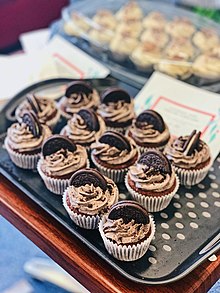
Cupcakes baked with baking soda as a raising amanuensis
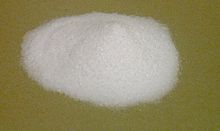
Sodium bicarbonate (IUPAC name: sodium hydrogencarbonate [9]), commonly known every bit baking soda or bicarbonate of soda, is a chemical compound with the formula NaHCO3 . Information technology is a table salt equanimous of a sodium cation (Na+) and a bicarbonate anion (HCO3 −). Sodium bicarbonate is a white solid that is crystalline, just often appears as a fine powder. Information technology has a slightly salty, alkaline taste resembling that of washing soda (sodium carbonate). The natural mineral form is nahcolite. It is a component of the mineral natron and is plant dissolved in many mineral springs.[10]
Nomenclature [edit]
Because it has long been known and widely used, the salt has many dissimilar names such as blistering soda, staff of life soda, cooking soda, and bicarbonate of soda and tin can frequently be found about blistering pulverisation in stores. The term baking soda is more mutual in the United States, while bicarbonate of soda is more common in Australia, United Kingdom and Republic of ireland.[11] and in many northern/key European countries it is called Natron. Abbreviated colloquial forms such as sodium bicarb, bicarb soda, bicarbonate, and bicarb are common.[12]
The discussion saleratus, from Latin sal æratus (meaning "aerated salt"), was widely used in the 19th century for both sodium bicarbonate and potassium bicarbonate.[13]
Its E number food additive code is E500.[14]
The prefix bi in bicarbonate comes from an outdated naming system predating molecular knowledge in reference to the two molar equivalents of carbon dioxide (known as carbonic acid in the aboriginal chemical science language) that potassium hydrocarbonate/bicarbonate releases upon decomposition to (di)potassium carbonate and to potassium oxide (potash).[15] The modern chemical formulas of these compounds now express their precise chemical compositions which were unknown when the name bi-carbonate of potash was coined (see besides: bicarbonate).
Uses [edit]
Cooking [edit]
Leavening [edit]
In cooking, baking soda is primarily used in baking every bit a leavening agent. When information technology reacts with acid, carbon dioxide is released, which causes expansion of the batter and forms the characteristic texture and grain in cakes, quick breads, soda bread, and other baked and fried foods. The acid–base reaction can be generically represented as follows:[16]
- NaHCO3 + H+ → Na+ + CO2 + H2O
Acidic materials that induce this reaction include hydrogen phosphates, cream of tartar, lemon juice, yogurt, buttermilk, cocoa, and vinegar. Baking soda may exist used together with sourdough, which is acidic, making a lighter product with a less acidic gustatory modality.[17]
Heat can also by itself crusade sodium bicarbonate to deed as a raising agent in baking considering of thermal decomposition, releasing carbon dioxide at temperatures higher up 80 °C (180 °F), as follows:[18]
- 2 NaHCOthree → Na2CO3 + HiiO + CO2
When used this fashion on its ain, without the presence of an acidic component (whether in the batter or by the use of a baking pulverization containing acrid), but half the available COtwo is released (one COii molecule is formed for every two equivalents of NaHCO3). Additionally, in the absenteeism of acid, thermal decomposition of sodium bicarbonate also produces sodium carbonate, which is strongly alkaline and gives the broiled product a biting, "soapy" taste and a yellow color. Since the reaction occurs slowly at room temperature, mixtures (cake batter, etc.) can be immune to stand up without rise until they are heated in the oven.[ citation needed ]
Blistering pulverisation [edit]
Baking powder, likewise sold for cooking, contains effectually thirty% of bicarbonate, and diverse acidic ingredients which are activated by the addition of h2o, without the need for additional acids in the cooking medium.[19] [20] [21] Many forms of blistering powder comprise sodium bicarbonate combined with calcium acid phosphate, sodium aluminium phosphate, or cream of tartar.[22] Baking soda is alkali metal; the acid used in baking pulverisation avoids a metallic taste when the chemical change during blistering creates sodium carbonate.[23]
Pyrotechnics [edit]
Sodium bicarbonate is one of the main components of the common "black serpent" firework. The effect is caused past the thermal decomposition, which produces carbon dioxide gas to produce a long ophidian-like ash as a combustion product of the other main component, sucrose.[24] Sodium bicarbonate is also used to filibuster combustion reactions by releasing COtwo and H2O when heated, both of which are flame retardants.
Mild disinfectant [edit]
It has weak disinfectant properties,[25] [26] and information technology may be an effective fungicide against some organisms.[27] Because baking soda will absorb musty smells, it has go a reliable method for used volume sellers when making books less malodorous.[28]
Fire extinguisher [edit]
Sodium bicarbonate tin can be used to extinguish modest grease or electric fires by being thrown over the fire, equally heating of sodium bicarbonate releases carbon dioxide.[29] Still, it should not exist applied to fires in deep fryers; the sudden release of gas may cause the grease to splatter.[29] Sodium bicarbonate is used in BC dry chemical fire extinguishers as an alternative to the more than corrosive diammonium phosphate in ABC extinguishers. The alkaline metal nature of sodium bicarbonate makes it the but dry chemical agent, besides Royal-K, that was used in large-scale burn suppression systems installed in commercial kitchens. Because it can act equally an alkali, the agent has a mild saponification effect on hot grease, which forms a smothering, soapy cream.[ citation needed ]
Neutralization of acids [edit]
Sodium bicarbonate reacts spontaneously with acids, releasing COii gas as a reaction product. It is usually used to neutralize unwanted acid solutions or acid spills in chemical laboratories.[xxx] It is not appropriate to utilize sodium bicarbonate to neutralize base[31] fifty-fifty though it is amphoteric, reacting with both acids and bases.[ commendation needed ]
Agronomics [edit]
Sodium bicarbonate when practical on leaves, can foreclose the growth of fungi; however, it does not kill the fungus. Excessive amount of sodium bicarbonate can cause discolouration of fruits (two percentage solution) and chlorosis (one percent solution).[32]
Medical uses and wellness [edit]
Sodium bicarbonate mixed with h2o can be used equally an antacid to treat acrid indigestion and heartburn.[33] Its reaction with breadbasket acid produces salt, water, and carbon dioxide:
- NaHCO3 + HCl → NaCl + H2O + COii(chiliad)
A mixture of sodium bicarbonate and polyethylene glycol such as PegLyte,[34] dissolved in water and taken orally, is an effective gastrointestinal lavage preparation and laxative prior to gastrointestinal surgery, gastroscopy, etc.[ citation needed ]
Intravenous sodium bicarbonate in an aqueous solution is sometimes used for cases of acidosis, or when bereft sodium or bicarbonate ions are in the blood.[35] In cases of respiratory acidosis, the infused bicarbonate ion drives the carbonic acid/bicarbonate buffer of plasma to the left, and thus raises the pH. For this reason, sodium bicarbonate is used in medically supervised cardiopulmonary resuscitation. Infusion of bicarbonate is indicated only when the blood pH is markedly low (< seven.1–7.0).[36]
HCOthree − is used for handling of hyperkalemia, equally information technology volition drive 1000+ dorsum into cells during periods of acidosis.[37] Since sodium bicarbonate tin cause alkalosis, information technology is sometimes used to treat aspirin overdoses. Aspirin requires an acidic environment for proper absorption, and a basic environment will diminish aspirin absorption in cases of overdose.[38] Sodium bicarbonate has also been used in the treatment of tricyclic antidepressant overdose.[39] Information technology tin also exist applied topically as a paste, with three parts blistering soda to i function water, to relieve some kinds of insect bites and stings (too equally accompanying swelling).[40]
Some alternative practitioners, such as Tullio Simoncini, take promoted baking soda as a cancer cure, which the American Cancer Guild has warned against due to both its unproven effectiveness and potential danger in use.[41] Edzard Ernst has called the promotion of sodium bicarbonate as a cancer cure "one of the more than sickening alternative cancer scams I have seen for a long fourth dimension".[42]
Sodium bicarbonate can be added to local anesthetics, to speed up the onset of their effects and make their injection less painful.[43] It is as well a component of Moffett'due south solution, used in nasal surgery.[ citation needed ]
It has been proposed that acidic diets weaken bones.[44] One systematic meta-analysis of the enquiry shows no such effect.[45] Some other also finds that there is no evidence that alkaline diets meliorate bone health, but suggests that at that place "may be some value" to alkaline diets for other reasons.[46]
Antacid (such as baking soda) solutions accept been prepared and used by protesters to alleviate the furnishings of exposure to tear gas during protests.[ failed verification ] [47]
Similarly to its use in baking, sodium bicarbonate is used together with a balmy acid such every bit tartaric acrid as the excipient in effervescent tablets: when such a tablet is dropped in a glass of water, the carbonate leaves the reaction medium equally carbon dioxide gas (HCO3 − + H+ → H2O + COtwo↑ or, more precisely, HCO3 − + H3O+ → 2 HiiO + CO2↑). This makes the tablet disintegrate, leaving the medication suspended and/or dissolved in the h2o together with the resulting common salt (in this example, sodium tartrate).[48]
Personal hygiene [edit]
Sodium bicarbonate is too used equally an ingredient in some mouthwashes. It has anticaries and abrasive properties.[49] Information technology works as a mechanical cleanser on the teeth and gums, neutralizes the product of acrid in the mouth, and besides acts every bit an antiseptic to help foreclose infections.[l] [51] Sodium bicarbonate in combination with other ingredients can exist used to make a dry or wet deodorant.[52] [53] Sodium bicarbonate may be used as a buffering amanuensis, combined with table salt, when creating a solution for nasal irrigation.[54]
It is used in middle hygiene to treat blepharitis. This is done by addition of a teaspoon of sodium bicarbonate to cool water that was recently boiled, followed by gentle scrubbing of the eyelash base with a cotton fiber swab dipped in the solution.[55] [56]
Veterinarian uses [edit]
Sodium bicarbonate is used as a cattle feed supplement, in item equally a buffering amanuensis for the rumen.[57]
Cleaning agent [edit]
Sodium bicarbonate is used in a procedure for removing pigment and corrosion called sodablasting. Equally a blasting medium, sodium bicarbonate is used to remove surface contamination from softer and less resilient substrates such as aluminium, copper or timber which could exist damaged by silica sand abrasive media.[58]
A manufacturer recommends a paste fabricated from baking soda with minimal h2o as a gentle scouring powder,[29] and is useful in removing surface rust, as the rust forms a water-soluble compound when in a concentrated alkaline solution;[59] cold water should be used, as hot-water solutions tin corrode steel.[60] Sodium bicarbonate attacks the thin protective oxide layer that forms on aluminium, making information technology unsuitable for cleaning this metal.[61] A solution in warm water will remove the tarnish from silver when the silver is in contact with a piece of aluminium foil.[61] [62] Baking soda is unremarkably added to washing machines as a replacement for water softener and to remove odors from dress. It is also almost as effective in removing heavy tea and java stains from cups every bit Sodium hydroxide, when diluted with warm water.
During the Manhattan Projection to develop the nuclear bomb in the early 1940s, the chemical toxicity of uranium was an upshot. Uranium oxides were constitute to stick very well to cotton textile, and did not wash out with soap or laundry detergent. However, the uranium would wash out with a two% solution of sodium bicarbonate. Clothing tin can become contaminated with toxic dust of depleted uranium (DU), which is very dense, hence used for counterweights in a civilian context, and in armour-piercing projectiles. DU is not removed by normal laundering; washing with virtually 6 ounces (170 g) of baking soda in two gallons (7.five L) of h2o volition help to wash it out.[63]
Olfactory property control [edit]
Information technology is frequently claimed that blistering soda is an effective scent remover,[64] [ better source needed ] and it is often recommended that an open up box be kept in the fridge to absorb olfactory property.[65] This idea was promoted by the leading U.Due south. brand of baking soda, Arm & Hammer, in an advertising entrada starting in 1972.[66] Though this campaign is considered a classic of marketing, leading within a twelvemonth to more than one-half of American refrigerators containing a box of baking soda,[67] [68] at that place is little evidence that it is in fact constructive in this application.[69] [seventy]
Chemistry [edit]
Sodium bicarbonate is an amphoteric compound. Aqueous solutions are mildly alkaline due to the formation of carbonic acid and hydroxide ion:
- HCO −
three + H2O → H
2 CO
3 + OH−
Sodium bicarbonate tin can ofttimes be used equally a safer alternative to sodium hydroxide, and every bit such can be used as a wash to remove whatever acidic impurities from a "crude" liquid, producing a purer sample. Reaction of sodium bicarbonate and an acrid produces a salt and carbonic acid, which readily decomposes to carbon dioxide and h2o:
- NaHCOthree + HCl → NaCl + H2CO3
- HtwoCO3 → H2O + CO2(g)
Sodium bicarbonate reacts with acetic acid (found in vinegar), producing sodium acetate, water, and carbon dioxide:
- NaHCO3 + CHthreeCOOH → CHiiiCOONa + H2O + COii(g)
Sodium bicarbonate reacts with bases such as sodium hydroxide to class carbonates:
- NaHCO3 + NaOH → NatwoCO3 + H2O
Thermal decomposition [edit]
At temperatures from 80–100 °C (176–212 °F), sodium bicarbonate gradually decomposes into sodium carbonate, h2o, and carbon dioxide. The conversion is faster at 200 °C (392 °F):[71]
- 2 NaHCO3 → Na2CO3 + H2O + CO2
Most bicarbonates undergo this aridity reaction. Further heating converts the carbonate into the oxide (higher up 850 °C/1,560 °F):[71]
- Na2CO3 → Na2O + COii
These conversions are relevant to the utilise of NaHCO3 every bit a fire-suppression amanuensis ("BC powder") in some dry-powder fire extinguishers.[ citation needed ]
Stability and shelf life [edit]
If kept cool (room temperature) and dry out (an airtight container is recommended to keep out moist air), sodium bicarbonate can be kept without a significant corporeality of decomposition for at least two or iii years.[72] [73] [74] [75]
History [edit]
The word natron has been in use in many languages throughout modern times (in the forms of anatron, natrum and natron) and originated (like Castilian, French and English natron likewise as 'sodium') via Arabic naṭrūn (or anatrūn; cf. the Lower Egyptian "Natrontal" Wadi El Natrun, where a mixture of sodium carbonate and sodium hydrogen carbonate for the dehydration of mummies was used [76]) from Greek nítron (νίτρον) (Herodotus; Attic lítron (λίτρον)), which can be traced back to aboriginal Egyptian ntr. The Greek nítron (soda, saltpeter) was likewise used in Latin (sal) nitrum and in German Salniter (the source of Nitrogen, Nitrat etc.).[77] [78]
In 1791, French chemist Nicolas Leblanc produced sodium carbonate, too known every bit soda ash. The pharmacist Valentin Rose the Younger is credited with the discovery of sodium bicarbonate in 1801 in Berlin. In 1846, 2 American bakers, John Dwight and Austin Church, established the start factory in the United states of america to produce baking soda from sodium carbonate and carbon dioxide.[79]
Saleratus, potassium or sodium bicarbonate, is mentioned in the novel Captains Courageous past Rudyard Kipling as existence used extensively in the 1800s in commercial angling to prevent freshly caught fish from spoiling.[80]
In 1919, The states Senator Lee Overman alleged that bicarbonate of soda could cure the Spanish flu. In the midst of the debate on 26 January 1919, he interrupted the discussion to denote the discovery of a cure. "I want to say, for the benefit of those who are making this investigation," he reported, "that I was told by a judge of a superior court in the mountain country of N Carolina they have discovered a remedy for this disease." The purported cure unsaid a critique of modern scientific discipline and an appreciation for the simple wisdom of simple people. "They say that common baking soda volition cure the disease," he continued, "that they have cured information technology with information technology, that they have no deaths up there at all; they use mutual baking soda, which cures the affliction."[81]
Production [edit]
Sodium bicarbonate is produced industrially from sodium carbonate:[82]
- NaiiCO3 + COtwo + H2O → 2 NaHCO3
It is produced on the scale of almost 100,000 tonnes/year (equally of 2001)[ dubious ] [83] with a worldwide product chapters of ii.4 million tonnes per year (every bit of 2002).[84] Commercial quantities of blistering soda are also produced by a similar method: soda ash, mined in the class of the ore trona, is dissolved in water and treated with carbon dioxide. Sodium bicarbonate precipitates as a solid from this solution.[ citation needed ]
Regarding the Solvay process, sodium bicarbonate is an intermediate in the reaction of sodium chloride, ammonia, and carbon dioxide. The production however shows low purity (75pc).[ citation needed ]
- NaCl + CO2 + NH3 + H2O → NaHCO3 + NH4Cl
Although of no practical value, NaHCO3 may be obtained past the reaction of carbon dioxide with an aqueous solution of sodium hydroxide:[ citation needed ]
- COii + NaOH → NaHCO3
Mining [edit]
Naturally occurring deposits of nahcolite (NaHCOiii) are found in the Eocene-age (55.8–33.9 Mya) Green River Formation, Piceance Bowl in Colorado. Nahcolite was deposited as beds during periods of loftier evaporation in the basin. Information technology is commercially mined using common secret mining techniques such as bore, pulsate, and longwall mining in a fashion very like to coal mining.[ commendation needed ]
It is as well produced by solution mining, pumping heated water through nahcolite beds and crystalizing the dissolved nahcolite through a cooling crystallization process.
In popular civilization [edit]
Sodium bicarbonate, every bit "bicarbonate of soda", was a frequent source of punch lines for Groucho Marx in Marx Brothers movies. In Duck Soup, Marx plays the leader of a nation at war. In one scene, he receives a message from the battlefield that his general is reporting a gas attack, and Groucho tells his aide: "Tell him to accept a teaspoonful of bicarbonate of soda and a one-half a drinking glass of water."[85] In A Nighttime at the Opera, Groucho's character addresses the opening night crowd at an opera by saying of the lead tenor: "Signor Lassparri comes from a very famous family. His mother was a well-known bass singer. His father was the get-go man to stuff spaghetti with bicarbonate of soda, thus causing and curing indigestion at the aforementioned time."[86]
In the Joseph L. Mankewicz archetype All About Eve, the Max Fabian character (Gregory Ratoff) has an extended scene with Margo Channing (Bette Davis) in which, suffering from heartburn, he requests so drinks bicarbonate of soda, eliciting a prominent burp. Channing promises to ever keep a box of bicarb with Max'due south name on information technology.
See also [edit]
- Carbonic acid
- List of ineffective cancer treatments
- List of minerals
- Natron
- Natrona (disambiguation)
- Trona
References [edit]
- ^ a b Haynes, p. 4.xc
- ^ a b c Haynes, p. five.194
- ^ a b c "Sodium Bicarbonate" (PDF). United nations Environment Plan. Archived from the original (PDF) on xvi May 2011.
- ^ Ellingboe JL, Runnels JH (1966). "Solubilities of Sodium Carbonate and Sodium Bicarbonate in Acetone-H2o and Methanol-Water Mixtures". J. Chem. Eng. Data. 11 (3): 323–324. doi:10.1021/je60030a009.
- ^ a b Haynes, p. 7.23
- ^ Pasquali I, Bettini R, Giordano F (2007). "Thermal behaviour of diclofenac, diclofenac sodium and sodium bicarbonate compositions". Journal of Thermal Analysis and Calorimetry. 90 (3): 903–907. doi:10.1007/s10973-006-8182-1. S2CID 95695262.
- ^ a b c d Haynes, p. 5.19
- ^ Chambers M. "Sodium bicarbonate [USP:January]". ChemIDplus. U.S. National Library of Medicine.
- ^ Classification of Inorganic Chemical science IUPAC Recommendations 2005 (PDF), IUPAC, p. 137, archived (PDF) from the original on 18 May 2017
- ^ "Mineral Springs – an overview | ScienceDirect Topics".
- ^ "What'due south the difference between bicarbonate of soda, baking soda and baking powder?". ThatsLife! Pacific Network.
- ^ PubChem. "Sodium bicarbonate". pubchem.ncbi.nlm.nih.gov . Retrieved 25 January 2021.
- ^ "Definition of SALERATUS". world wide web.merriam-webster.com . Retrieved half-dozen December 2020.
- ^ "Approved additives and E numbers". Food Standards Agency . Retrieved vii December 2020.
- ^ Wollaston, WH (January 1814). "I. A Synoptic calibration of chemical equivalents". Philosophical Transactions of the Royal Society of London. 104: 1–22. doi:x.1098/rstl.1814.0001. S2CID 96774986.
- ^ Aptitude AJ, ed. (1997). The Technology of Block Making (six ed.). Springer. p. 102. ISBN9780751403497 . Retrieved 12 August 2009.
- ^ Cascio J. "Sourdough" (PDF). University of Alaska Fairbanks Cooperative Extension Service. FNH-00061. Archived from the original (PDF) on 27 March 2016. Retrieved 2 May 2017.
- ^ "The Many Practical Uses of Baking Soda in the Kitchen". Nigh.com Food . Retrieved 22 January 2017.
- ^ Czernohorsky JH, Hooker R. "The Chemistry of Blistering" (PDF). New Zealand Institute of Chemical science. Archived from the original (PDF) on 27 Nov 2016. Retrieved 22 Jan 2017.
- ^ "Baking Soda and Blistering Powder". FineCooking.com . Retrieved 22 Jan 2017.
- ^ "Baking Soda FAQs". Arm & Hammer Multi-Brand. Church building & Dwight Visitor. What is the difference baking soda and baking powder?. Archived from the original on 27 June 2017. Retrieved 20 July 2017.
- ^ "Glossary Ingredients". Cooking.com. Archived from the original on 15 September 2008.
- ^ "Sodium Bicarbonate". BRP Adhikary. xi July 2016. Retrieved 25 Jan 2021.
- ^ "Saccharide snake". MEL Science. MEL Scientific discipline 2015–2019. Archived from the original on 6 Oct 2019. Retrieved 28 Oct 2019.
- ^ Malik YS, Goyal SM (May 2006). "Virucidal efficacy of sodium bicarbonate on a food contact surface against feline calicivirus, a norovirus surrogate". International Journal of Nutrient Microbiology. 109 (i–ii): 160–3. doi:ten.1016/j.ijfoodmicro.2005.08.033. PMID 16540196.
- ^ Rutala WA, Barbee SL, Aguiar NC, Sobsey Physician, Weber DJ (January 2000). "Antimicrobial activity of home disinfectants and natural products against potential human pathogens". Infection Control and Hospital Epidemiology. 21 (1): 33–eight. doi:10.1086/501694. PMID 10656352. S2CID 34461187.
- ^ Zamani M, Sharifi Tehrani A, Ali Abadi AA (2007). "Evaluation of antifungal activity of carbonate and bicarbonate salts alone or in combination with biocontrol agents in control of citrus greenish mold". Communications in Agronomical and Applied Biological Sciences. 72 (4): 773–vii. PMID 18396809.
- ^ Altman M (22 May 2006). "Book Repair for BookThinkers: How To Remove Odors From Books". The BookThinker (69).
- ^ a b c "Arm & Hammer Baking Soda – Basics – The Magic of Arm & Hammer Blistering Soda". armandhammer.com. Archived from the original on 31 August 2009. Retrieved 30 July 2009.
- ^ "Fix for Emergencies from Uncontrolled Hazards". American Chemical Society.
- ^ Hurum D. "Laboratory Safety" (PDF). Civil Engineering. Northwestern University.
- ^ "Horticulture myths". Academy of Vermont Extension Section of Plant and Soil Science. Archived from the original on 7 August 2019. Retrieved xviii October 2021.
- ^ "Sodium Bicarbonate". Jackson Siegelbaum Gastroenterology. 1998. Archived from the original on v October 2016. Retrieved 4 October 2016.
- ^ "PegLyte". Pendo Phama.
- ^ "Sodium Bicarbonate Intravenous Infusion" (PDF). Consumer Medicine Information. Better Wellness Channel. 13 July 2004. Archived from the original (PDF) on 22 August 2008.
- ^ "Respiratory Acidosis: Treatment & Medication". emedicine. 26 March 2020.
- ^ Sprint RC (2004). Medical Toxicology. Lippincott Williams & Wilkins. pp. 910–. ISBN978-0-7817-2845-4.
- ^ Cloth Diapers. Donald C. Cooper PhD. pp. 46–.
- ^ [ old info ] Knudsen G, Abrahamsson J (Apr 1997). "Epinephrine and sodium bicarbonate independently and additively increase survival in experimental amitriptyline poisoning". Critical Care Medicine. 25 (4): 669–74. doi:10.1097/00003246-199704000-00019. PMID 9142034.
- ^ "Insect bites and stings: Offset aid". Mayo Clinic. 15 Jan 2008.
- ^ "Sodium Bicarbonate". American Cancer Social club. 28 Nov 2008. Archived from the original on 19 Feb 2013. Retrieved 19 Feb 2013.
{{cite spider web}}: CS1 maint: unfit URL (link) - ^ Ernst E (3 February 2017). "This must be the most sickening cancer scam I have seen for a while".
- ^ Edgcombe H, Hocking G, Radcliffe J (2005). "Anaesthesia U.k. : Local Anaesthetic Pharmacology". John Radcliffe Hospital, Oxford, UK.
- ^ Fob D (15 Dec 2001). "Hard cheese". New Scientist . Retrieved 20 July 2017.
- ^ Tanis R. Fenton, Suzanne C. Tough, Andrew W. Lyon, Misha Eliasziw, David A. Hanley, "Causal assessment of dietary acid load and bone disease: a systematic review & meta-assay applying Loma's epidemiologic criteria for causality", Nutrition Periodical 10:41 (Apr 2011), doi:x.1186/1475-2891-10-41, full text
- ^ Gerry K. Schwalfenberg, The Alkaline Diet: Is There Evidence That an Element of group i pH Diet Benefits Health?, Journal of Environmental and Public Health 2012:727630, doi:10.1155/2012/727630
- ^ "Medical information from Prague 2000". Archived from the original on eighteen October 2014.
- ^ Shirsand, Southward. B.; Suresh, Sarasija; Jodhana, 50. S.; Swamy, P. Five. (2010). "Conception Design and Optimization of Fast Disintegrating Lorazepam Tablets by Effervescent Method". Indian Periodical of Pharmaceutical Sciences. 72 (4): 431–436. doi:ten.4103/0250-474X.73911. ISSN 0250-474X. PMC3013557. PMID 21218052.
- ^ Storehagen S, Ose Due north, Midha S. "Dentifrices and mouthwashes ingredients and their apply" (PDF). Institutt for klinisk odontologi. Universitetet i Oslo.
- ^ U.s.a. 4132770A, Barth J, "Oral Product", issued 1979
- ^ Iqbal K, Asmat M, Jawed S, Mushtaque A, Mohsin F, Hanif South, et al. (July 2011). "Role of unlike ingredients of tooth pastes and mouthwashes in oral health" (PDF). Journal of Islamic republic of pakistan Dental Association. 20 (3): 163–70.
- ^ Lamb JH (1946). "Sodium Bicarbonate: An Excellent Deodorant". The Journal of Investigative Dermatology. seven (3): 131–133. doi:10.1038/jid.1946.13.
- ^ "Bicarb soda: natural torso deodorant". sustainableecho.com. 10 March 2009.
- ^ Metson RB (2005). The Harvard Medical School Guide to Healing Your Sinues. McGraw Hill. p. 68. ISBN9780071444699.
- ^ "Blepharitis : Information for patients leaflet" (PDF). Ouh.nhs.uk . Retrieved 28 Feb 2022.
- ^ "Blepharitis. Treatment and Causes. Eyelid inflammation | Patient". Patient. Archived from the original on v Dec 2015. Retrieved 31 May 2016.
- ^ Paton LJ, Beauchemin KA, Veira DM, von Keyserlingk MA (2006). "Use of sodium bicarbonate, offered complimentary pick or blended into the ration, to reduce the chance of ruminal acidosis in cattle". Canadian Journal of Animate being Scientific discipline. 86 (3): 429–437. doi:10.4141/A06-014.
- ^ "Blast Away Crud With Baking Soda". Popular Mechanics. 5 August 2013. Retrieved ii August 2020.
- ^ Housecroft CE, Sharpe AG (2008). "Chapter 22: d-cake metal chemistry: the first row elements". Inorganic Chemistry, 3rd Edition. Pearson. p. 716. ISBN978-0-13-175553-half-dozen.
- ^ "Science Lab.com". MSDS- Sodium carbonate. sciencelab.com. Archived from the original on v September 2012.
- ^ a b "Finishing Techniques in Metalwork". Philadelphia Museum of Fine art.
- ^ "Put a Shine on It". scifun.chem.wisc.edu. Archived from the original on 31 July 2012. Retrieved 6 March 2011.
- ^ Orcutt JA. "Depleted Uranium and Wellness: Facts and Helpful Suggestions". Pharmacology and Toxicology of Uranium Compounds. McGraw-Colina. Archived from the original on 17 January 2013. Retrieved 21 March 2012.
- ^ Raymond J (10 June 2016). "Kitchen Odor Eliminating Candles, Products, and Tricks". cravedujour.com. Archived from the original on 7 August 2020. Retrieved 29 June 2016.
- ^ Vicki Lansky, Martha Campbell, Baking Soda: Over 500 Fabulous, Fun, and Frugal Uses You've Probably Never Idea Of, 2009, ISBN 1931863733, p. 28
- ^ "A trusted solution for more than 170 years. Pure and elementary.", Arm & Hammer "About United states" page
- ^ Keith Sawyer, Group Genius: The Creative Ability of Collaboration, 2017, ISBN 0465093582, "keep food tasting fresh"
- ^ Clayton G. Christensen, Scott Cook, Taddy Hall, Marketing Malpractice: The Cause and the Cure, Harvard Business Review, December 2005, [1]
- ^ "Myth #100: An Open Box of Blistering Soda in the Fridge absorbs Odors", Bruce Weinstein, Mark Scarbrough, Lobsters Scream When You lot Boil Them; And 100 Other Myths About Nutrient and Cooking, 2011, ISBN 1439195382, p. 312
- ^ "Blistering Soda as Odor Cushion | Cook'south Illustrated". Cooksillustrated.com . Retrieved 28 February 2022.
- ^ a b "Decomposition of Carbonates". Full general Chemistry Online. Archived from the original on 2 October 1999. Retrieved 16 March 2010.
- ^ PubChem. "Sodium bicarbonate". pubchem.ncbi.nlm.nih.gov . Retrieved xvi May 2021.
- ^ "Sodium bicarbonate (S300) batch numbering and shelf life statement – Solvay Chemicals, Inc" (PDF). 31 January 2019.
- ^ "Re: Shelf Life – Sodium Bicarbonate (all grades) – Tronox Alkali Corporation" (PDF). i April 2015.
- ^ "Does Baking Soda Go Bad? How to Know If It's Notwithstanding Good". The Bandbox Eats . Retrieved 16 May 2021.
- ^ Renate Gerner: Instruments and substances used in mummification. In: Renate Gerner, Rosemarie Drenkhahn (ed.): Mumie und Computer. A multidisciplinary research project in Hanover. Special exhibition of the Kestner Museum Hanover from September 26, 1991 to January 19, 1992. Kestner Museum, Hanover 1991, ISBN 3-924029-17-2, p. 28 f.
- ^ Franz Dornseiff: "The Greek words in German language." Walter de Gruyter & Co, Berlin 1950, p. 44.
- ^ Friedrich Kluge, Alfred Götze (Philologist): Etymological Dictionary of the High german Language. 20th edition, ed. by Walther Mitzka, De Gruyter, Berlin / New York 1967; Reprint ("21st unchanged edition") ibid 1975, ISBN 3-11-005709-3, p. 504.
- ^ "Company History". Church & Dwight Co. Archived from the original on 16 October 2011.
- ^ Kipling R (1897). Captains Courageous. p. 25.
- ^ Bristow, Nancy K. (2012), American Pandemic: The Lost Worlds of the 1918 Influenza Epidemic, Oxford Academy Press, p. 178, ISBN978-0199811342
- ^ Thieme C (2000). "Sodium Carbonates". Ullmann's Encyclopedia of Industrial Chemistry. Weinheim: Wiley-VCH. doi:10.1002/14356007.a24_299. ISBN3527306730.
- ^ Holleman AF, Wiberg E (2001). Inorganic Chemistry. San Diego: Academic Press. ISBN0-12-352651-5.
- ^ Folio 45, section 3.6.2.1 of "Process Best Practices Reference Document (BREF) for Soda Ash," report produced past the European Soda Ash Producer'due south Association Archived three Oct 2006 at the Wayback Machine, March 2004. Archived at WebCite from this original URL Archived ane March 2008 at WebCite on 1 March 2008.
- ^ "Duck Soup (1933)". IMDb . Retrieved 4 August 2015.
- ^ "A Night at the Opera (1935)". IMDb . Retrieved 4 August 2015.
Bibliography [edit]
- Haynes WM, ed. (2011). CRC Handbook of Chemical science and Physics (92nd ed.). CRC Press. ISBN978-1439855119.
External links [edit]
- International Chemical Safe Card 1044
Source: https://en.wikipedia.org/wiki/Sodium_bicarbonate
Posted by: krauswrife1955.blogspot.com
0 Response to "Is Baking Soda A Chemical Or Chemical Makeup"
Post a Comment